Recap: No one can get in and out of Hokitika because the bus
does not go down the west coast that far, because of the washed out bridge just
to the south. I was south of the washed out bridge, but then I took a plane
OVER it. But now I am in Hokitika, and unable to get OUT of Hokitika, because
the bus doesn’t go down that far. There
are no cars, the shuttle and taxis all cost a hundred dollars. The manager of
the hostel is very upset because the lack of a bus coming down means he has no
customers. There, all caught up.
The
hostel at Hokitika is pretty much empty.
I’ll
find out, later, that there’s a large group of men staying there, as well as a
young kiwi family (with a small, shrieking child that the parents do nothing to
train or curtail in any way shape or form), and an older German couple, but when
I trudge into the hostel it all seems very quiet and very very empty. When a
hostel is supposed to hold two or three times that number of people, when the
room I’m staying in has eight beds and I’m the only one in there—well, I
thought it was kind of nice. It means I have the whole room to myself (yes, I
will lay out my jeans all over that spare bed. And my keys can go just there,
on the windowsill, and I don’t mind if I DO put my shoes by the door, , and I’m
going to turn the lights on and off when I decide they need to go on and off!
So take THAT!).
The
hostel is similar to other hostels in that they’ve tried to inject a youthful
vibe with bizarre decoration schemes that sort of work: the walls in the
kitchen and hallways are painted in various broad cartoon illustrations of
birds flipping eggs, or a cadre of animal friends driving caravans, and going
to the showers with bath caps and towels slung over their shoulders. In my
room, an illustration of a cat in a cross legged yoga position takes up one
full wall, its face squniched into some sort of half stoned, half sleepy
caricature of “cat at yoga rest.” The main room, the living room, with couches,
TV and a large table where you can play cards, has a sliding door to a balcony,
and one wall is completely glass paned, and actually allows you to see down
below into the store that we’re perched above: the Jade factory.
Hokitika’s
main “thing” is jade. The Jade factory, where you can watch women actually
grinding Jade to make fancy jade necklaces in traditional Maori shapes and
spirals and fish hooks and whale tails, etc, is right below us. All the other
stores here in Hokitika sell Jade in much greater numbers than I’ve seen
throughout the rest of the country. I mean, yes, I’ve seen Jade being sold—it’s
like the country’s main souvenir, main item of note. When I was in Invercargill
one of the first items I bought, for my very good friend, was a Jade Necklace,
because it was clearly a very special item in a special store with special
Maori meanings and everything. They have
a lot of Jade rock, and it’s beautiful. But here in Hokitika it’s an obsession.
You can’t really go anywhere (read: Hokitika is basically four blocks long and
four blocks wide) without smacking into Jade this or Jade that.
I will
discover all this in the course of time. I cursorily look around the hostel, peer
into the Jade factory from the top floor, and move on. It’s midday, so the manager is just starting
to clean the kitchen. I tell him to keep an eye out for people with cars, but
he tells me the last chap with a car left this morning.
But
five minutes later, or maybe ten minutes, after I’ve put on my bathing suit,
BOUND AND DETERMINED TO GO TO THE BEACH, he knocks on my door, and tells me I
might be in luck. Someone with a car has
just come in, and is looking to go to Greymouth, north, exactly where I want to
go!
I
figure out later that the chap who left earlier that morning is this guy, who
is now here, because he didn’t realize that the bridge was washed out quite
THAT bad. He was hoping to go south, to some town where he would take some
fabulous three hundred dollar helicopter ride, but because of the bridge, he
could not get where he needed to go, and so came back to Hokitika within the
hour.
His
name is Marcus, and he’s—you guessed it—he’s German. Of course he’s German.
EVERYONE IN NEW ZEALAND IS GERMAN.
I ask
him if he would be willing to take me to Greymouth (while he’s changing his
pants. His door is open, I barge in, he’s in his underwear, I ask him, somehow
not noticing the underwear situation, and he’s like, “sure, that’s fine,” and
then ten minutes later I’m like, “Oh, shorts—you’re now in shorts, shorts are
your normal attire, not underpants. Oh. Ok. I should have maybe waited for you
to not be in underwear. Sorry about that. Sorry.”) And he says that’s fine, he
says yes, he will take me to Greymouth. He’s going up that way anyway, we’re
both traveling solo, and this is the perfect situation.
When
gas is ten dollars a liter (that’s forty dollars a gallon, folks), I am
amenable to spending five dollars for a half hour of driving with another
traveler who’s close to my age.
Anyway,
he says he’s not going to Greymouth until tomorrow because tomorrow he’ll go on
a short alpine plane ride (in lieu of his originally planned helicopter ride),
then we’ll drive a half hour to Greymouth, and I’ll pick up my bus to get to
Nelson, the place I wanted to get to in the first place.
So
everything is fine, and we have a day to kill. I am keen on the beach.
Marcus
wants to go on a walk to some lake. He shows me a map. The map is green, and
the lake is blue, and the area with the beach is orange. I do some hasty
deductions. I think, well, probably the green means trees. That’s good, but not
as good as orange, which means probably means sand.
“I’m
not as interested in a hike as I’m interested in the beach,” I say.
“Yah,
but I think this beach is not so good, there is a lot of—how do you say—the
dead wood, there.” Marcus has slightly
curly brown hair and a little spot of beard hair right under his lower lip.
I
frown. “Dead wood? You mean Drift wood? But that’s perfect. That’s exactly what
I want.”
Marcus
looks skeptical. I look skeptical about Marcus’s beach choosing skills. We try
to make a time to meet back up but eventually he says that he will just meet me
on the beach. I think that probably it will not happen, because the beach is a
big place. But whatever. We part ways.
I
wander around town a little bit. I find an arts and crafts market (they sell
jade necklaces, succulents, baby clothes, donuts, and organic candles). I find
an entire store that sells nothing but possum fur. Possum fur hats, gloves,
scarves, coats—you name it. Even possum fur nipple warmers. Yes. You read that
correctly. Possums are a problem in New Zealand because they strip the trees
really quickly—they eat the leaves and bark and the trees can’t recover, plus a
host of other problems. One of New Zealand’s greatest challenges is simply
killing all the animals—rats, stoats, possums, rabbits—that aren’t supposed to
be there, because they throw off the delicate balance of the island. So if you
really want a fur coat but feel bad about hurting a poor animal to get that fur
coat, order a possum coat from New Zealand. That possum was living on borrowed
time and borrowed soil anyway. Don’t worry; they’re just as expensive (and just
as soft).
I
eventually get to the beach.
Oh, AND
THIS BEACH IS SENT BY GOD AND LORD KRISHNA AND DOUGLAS ADAMS AND PROBABLY MY
MOTHER AS WELL (even though she is alive and well, but she really loves looking
for stones on beaches). So Much Drift Wood! So Many Stones! So Few People! So
Much Sun!
So I am
feeling Excellent. This morning I took an ALPINE FLIGHT, and now I am HERE.
I put
my backpack down behind a large driftwood log, and set to work, because this is
serious business. All of these stones! I leapfrog from one to the other. And
here’s one! And this one!
Eventually
I realize that I am collecting the wrong stones. The stones I am collecting are
nice, but the nicer stones are all
GREEN. There are GREEN stones—brilliantly deeply GREEN stones, that glimmer and
shine against the dark black sand, green stones with black lines or spots,
green stones with white lines or spots, solid green stones, half and half green
stones, square green stones, round green stones, plain green stones,
interesting green stones—the list goes on and on.
I take
the stones over to the driftwood log where my backpack is, high above the surf.
I put them in piles. This is so very very satisfying. I am so so happy. I am
trotting back and forth. I have piles of stones in my pockets and piles on the
log. Some piles are rejects but that I’ve kept there because I still like them
and I might make another pile, later, and will need more stones and will have
to draw from a reserve pile. So I have my reserve pile, and I have my currently
working on piles, and I’m searching for new stones, and the sea is bringing in
new stones with every wave. It’s wonderful. Truly truly wonderful.
At some
point I realize something horrific. The green color disappears when the stones
dry out. And I’m not going to be taking the stones back to the states wet—that would be too much extra weight.
They have to be dry. But when they’re dry they get white looking.
CURSE
YE GODS!
So then
I have to make MORE piles, drying OUT piles, I have to line all the rocks up,
and I have to make ELIMINATIONS, I have to think about which rocks will look
best both dry AND wet. But I’m not going to risk going back to the sea with a
handful of rocks to get them all wet again—some of these rocks are small. What
if I lost one and it tumbled into the surf? The obvious solution is just to
lick each stone so that I remember what the original green color looked like,
and so I can compare the dry color and the wet color, and make an educated
decision because of it.
This is
how Marcus finds me, on the beach, licking each stone, considering it, and then
carefully putting it back into specific piles on an old piece of driftwood.
He
says, “How does a stone taste?” He is trying to be nice.
I say,
“Salty! I think I got some sand in that last one—but look!” I pull out of my
pockets the DEFINITE groupings of rocks that I’ve already made. He dutifully
looks the groupings of rocks.
I am
making one last group of rocks. I am a little sad that he is here (although
happy to have company) because I really could make piles of rocks all afternoon,
and I can tell that he wants to move onto something else. I ask for his opinion
about the group of rocks—he tells me his opinion and I promptly ignore all of
it.
Marcus
asks if I want to swim, and I say, “yes, but I didn’t want to swim without a
partner.” He nods. I had thought about diving in earlier, the waves are waves
I’ve seen off the coast of North Carolina, before, where once you’re past the
breakers you’re fine, you can manage. There are a group of boys in wet suits
and boogey boards swimming—well, they swim, get pulled down the beach by the
current, get out before they hit a wall of large rocks a little ways down, get
out, run up the beach, and repeat the process. But it’s a new beach, a beach I
don’t know, and I don’t know where the drop off point is, and I don’t know what
the coast guard rules are here. So it’s good that Marcus is here.
He says
the water’s cold. I’ve been wading around in the surf all afternoon and my feet
and shins have gotten used to it—it’s not so bad. I tell him this. I tell him
that once our faces are wet the temperature regulators in our bodies will
adjust accordingly.
We
stride into the waves, into the breakers—not terribly rough—and HOLY FRITADAS,
it’s FREAKING FREEZING.
I’ve
been in my share of cold water. I’ve swum in Quarries in Maine, in the Ocean in
Maine. I got half and half wet in the ocean in California, too. But this is
like, so much colder—I don’t even know how it stands up to those cold levels.
With the other bodies of water I got used to them. It was cold but it was
doable. You move around a little, you get your head wet and all of a sudden you
realize you’ve been in the water for three hours and it’s time for dinner.
This is not doable. I have no idea why.
MAYBE
IT’S BECAUSE NEW ZEALAND IS NEXT TO ANTARCTICA.
Anyway.
We get out right quick.
Then we
spend the next several hours spread out on the beach, recovering, getting warm
again. He tells me he doesn’t like the Lord of the Rings. I give him hell for
that. Etc.
At six
o’clock the sun is only half way down the sky, and we have to walk a little way
down the beach to get back to town. It’s so warm, and Marcus is talking. It’s
difficult to concentrate, though, because Marcus is talking about gun control
in the U.S, but we’re on the beach with all those rocks. I do not know why he
wants to talk about gun control when there are ROCKS around, when I could be
looking for more ROCKS—
He asks
whether the media’s representation of gun control in America is accurate—do I
feel safe going to school, to the mall? The media in Europe convinces him that,
no, I do not. What do I think?
 |
| The Beach at Hokitika at Sunset--note the driftwood! |
But I’m
like, Look! A Rock! Oh and this one has red in it! Do I have enough red and
white rocks to go with all the green ones—Red and Green are on opposite sides
of the color wheel, sometimes that’s a good thing, and sometimes a bad thing.
Will it be a good thing? I should pick this one up. “Oh—um, maybe I feel safe.
Sure. No, wait. I DO feel safe. Lots of places in America are like Hokitika—you
feel safe here, right? It’s like that. Except when a shooter comes to somewhere
like here. Then everyone freaks out. Haha, DID YOU HEAR, DICK CHENEY SHOT HIS
FRIENDS FACE OFF, THE DICK.”
“What?
“Dick
Cheney shot his friends face off. Oh! And another rock! Do you like this one?”
“I think
you have too many rocks. Does that happen often?”
“How
could I have too many rocks? My bag does not feel too heavy when I wear it on
my hips.”
“Does
it happen often?”
“What?”
“Shooting
people in the face?”
“Oh!
No. I don’t think so. Most people—unless they’re stupid or insane, keep a hold
of their guns and are responsible. But guns are an identity---we have whole
stores—“oh I am bored and frustrated with this conversation already. Is it my
job to illuminate America’s problem with violence and assault weapons for
everyone I meet? “Is this a rock?” I pick up something round and hard, but also
with a hole at the top.
“No, it
is a seaweed pod.”
“Maybe
I should keep it anyway.”
“Whole
stores?”
“Yes.”
“Do you
own a gun?”
“Excuse
me?”
“It’s a
question.”
“I will
have you know that my class is Middle Class White Liberal Intellectual. We do
not own Guns. My Mother is from New York City.” I am haughty about this. I tell him that it’s an issue of poverty
level—that the rich keep the regulations loose, pay to keep the regulations
loose, and then that allows every crazy person in the joint to go nuts whenever
they want. Blah Blah Blah.
He
nods, but I think he’s a little overwhelmed. When we get back to the hostel we
both cook dinner (he chops up a quarter of a cabbage, cooks it down with salt
and pepper, and then eats it. I have a curry vegetable stir fry with coconut
cream, curry powder and thai spice, brown rice, and a melange of vegetables
from a farmer’s stand. He looks at my cutting board and says, “You have so many
vegetables.” I tried to ask if he wanted to do a combo thing for dinner, but he
didn’t,) and then afterwards we read each other’s fortunes. He is going to come
into some money and have an epiphany. I am going to live out Charlotte Bronte’s
Wuthering Heights. The Lover. The
Enemy. The War between the Lover and Enemy. The Falseness. The Big House. The
Illness. The Baby. The Widower. Etc.
I
discover that today, in the process of searching for stones and ribbing Marcus
about his distaste for Lord of the Rings, I got a huge sunburn, right across my
shoulders and arms. I forgot Sunblock, and New Zealand has less ozone in their
atmosphere than we do. The burn is worst on my left shoulder. I can already see
the tan line, and it’s already hot, even though it hasn’t been a full day yet. I don’t have
any aloe vera.
The
next morning I meet two more Germans, in the hostel kitchen. They ask me, as
everyone seems to ask me, “Why Rocks?”
It is difficult to answer that
question. What do you mean, why rocks. WHAT ELSE IS THERE? Eventually I tell
them about my mother and how she and my sister and father and I would search
for clear quartz during our beach vacations along the east coast. And that
seems to make sense, but it is not really the reason that I am picking up much
larger stones, grouping them in baggies, labeling them and bringing them home.
We never did that. I can’t really explain my current behavior.
The Germans say,
“Oh, but this beach is not so good, I think, it is covered in the dead wood.
You know New Zealand has some fonderful beaches, fonderful white sand with de
shells, lofely shells, but this beach is not so nice, I tink.”
And I’m
like, “What is wrong with you guys? This beach was CLEARLY the best beach.”
Anyway,
I tell them about how I flew over the washed out bridge so that I could get to
the ocean, because I missed it, because I came to New Zealand for the proximity
to the Ocean (OCEAN).
The man
asks me—well, he MEANS to ask me if I work with the ocean in my line of work,
but his actual words are, “Is the ocean vital for your life?”
I
look at him and I say, “Yes. Yes it is.” And he looks at me like that's some sort of crazy hippy answer. Maybe it is. But I feel constantly parched, in Iowa, like the bones in my arms are crumbling from the inside out. Megan White says this is a thing to do with Negative Ions.
In any case; I bid them farewell. Crazy Germans.
Marcus drives
me to Greymouth. We have a pleasant time, except that my sunburn and the rather
active day I had yesterday means that I’m a little groggier today. He drops me
off at the bus depot, and we say goodbye, and he takes off for his hostel. It
was fun, but I’m not sad to see him go.
I
travel by bus for five hours to Nelson, at the top of the South Island. Nelson
is supposed to be one of the sunniest areas of New Zealand. I am hoping for
more beach time. But on the bus my sunburn starts getting painful, and I’m
tired and groggy, and I have food but on the bus there’s a no eating rule.
So when
I get into Nelson I am on a fast track to bads-ville. I’m grumpy and tired and
I can’t hardly think in a straight line. I give the lady at the desk the print
out of my bus tickets and she says that actually, I haven’t booked enough
nights to get me from one bus ticket to the next—I have gotten days mixed up.
But she is nice and fixes things for me.
The
problem with traveling is that days get confusing. Dates get confusing, too.
The first things to go are days of the week—Saturday means nothing when every
day is Saturday. The next things to go are actual dates, which don’t mean
anything when you have no deadlines to reach for (some people are better at
this than others. If you don’t book or plan ahead of time, the dates break down
much faster than otherwise). So I
vaguely knew that I had four or three colored blocks in my head that I would
spend in Nelson, before another colored block that I would spend in Kaikora,
before another colored block that would mean I would fly home, but I could
really not tell you what those colored blocks meant in dates or times or
anything that corresponded to the real world.
But the
lady fixes everything for me, and the world is good.
When I
get to my room I find that it’s a mixed room—not a big deal—but that means that
somehow a family of Koreans is there. It’s rare to see older people in the
hostels, and I’m a little bit tense. Not because I think they’re going to harm
me, but because I don’t know how they’re going to act.
The
next morning I wake up feeling tired and gross and ill. I had gone to the
grocery store and gotten aloe vera lotion the night before, for my burn, but
that didn’t help so much as just short term soothe the skin. Still, I am
determined to make the most of the time in Nelson.
So I
put on short sleeves, to cover my shoulders, and I strike out. I will find the
beach. I will look for more stones, since I had such luck with it in Hokitika.
But Nelson
is like, a posh beach town. There are women in cute dresses. This is my first
indication that things are going to go badly. The ladies are wearing strappy
sandals and dresses that require either no bras or complicated bra
configurations, generally unknown to me. The men are in chinos and flashy
watches. Oh dear.
The
main street, I soon find out, is all high end fashion stores. Not a souvenir
shop in sight. I use the map in my head (which has been thrown off kilter
because I generally operate around Canada = north, Mexico= south,
Atlantic=East, Pacific =West, but here that is not a scheme to operate on,
since New Zealand is tilted, The Pacific is on the East, and people point to
South America, which seems an awful long way away) to guide me to where I think
the sea is, but I never make it. Instead, I make it to the travel guide place,
where I tell them I want to go to the beach, they put me on the bus, the bus
takes me fifteen minutes away to a nearby town, deposits me next to a small
beach which is all smooth white sand, clear green and blue water, and no rocks
or driftwood in sight.
The
Germans would have been absolutely delighted.
But I
am so bored.
I bob
around for a little while. This water is warm, even. I can see my feet.
But I
am so bored.
When
the wind picks up I get out, dry off, and figure out how to catch the bus back
to Nelson.
I just
want to take a shower and a nap, but when I get to the room, the Korean family
is there. Did they go out at all today? They were here this morning, before I
left, putzing around. Normally, young people are in the hostel rooms as little
as possible. But here they are. It's their room too, but it means that I have no privacy, no room or place to myself, no place where I don't have to be on guard, or at least polite. I have no place to just stop and relax. Around younger people I maybe wouldn't have worried about it, but they're older, and it's a strange, different dynamic. I am not comfortable at all. I feel like I have interrupted them in their personal hotel room. It doesn't feel right to interrupt their mid afternoon nap.
I pause for a moment and then leave.
The rest of the day is generally a bad day.
I pause for a moment and then leave.
The rest of the day is generally a bad day.
The
next day I feel infinitely better. I have more energy! I now realize that
Nelson is not the beach hotspot that I wanted for myself. Fine. I will do other
things. Instead I go to a giant church (no, I do not sleep in it), a couple
mediocre art galleries, and am generally searching for souvenir shops. Nelson
has no souvenir shops. It is utterly devoid of souvenir shops.
Instead
I end up at a museum. I am hesitant. But I pay seven dollars and go into the
first floor.
The
museum is supposed to be about the Taranaki wars, the wars between the Maori
people and the first white settlers. But the first floor is like some sort of
flashing, schizophrenic, denial wonderland. There are a couple amped up panels
with Maori stories about how their gods brought fishing nets back to the
village, but right next to those panels are panels about how white settlers
mined for various types of rocks, and across from that is information on glow
worms. And I’m like, this is not all from the same time period, nor even the
same genre of information, and there are no wars mentioned anywhere. Eventually
any mention of Maori anything disappears almost completely, and the museum
devolves into a display of settler’s first christening gowns, and the types of
sewing machines they used in the early years.
That
was not worth seven dollars.
I go
back out to the main hallway and I’m just about to leave when the lady at the
desk asks if I’ve been upstairs—there’s another portion. I race up there, and
that’s where everything good is.
The
upstairs starts off with a series of questions about how the Taranaki Wars
started—with the government? With greedy land sellers? With this
misunderstanding? With this figure? This series of questions allows a murky
beginning, a more complex beginning—rather than “And then the first shot was
fire and the war was on!” which is the inclination of many historians. I
appreciate the murkiness, and the levels of intricacy.
The
story continues on in this matter—describing the Maori’s initial contact with
white settlers as positive; the maori wanted to trade and coexist, as long as
the white settlers stayed in designated areas. Some of the Maori were more
willing than others to allow the white settlers on more land. Especially when they
realized that the British Government was keen to run them over they tried many
different ways of communicating and establishing themselves as a formidable
opponent—simply occupying the land they wished not to have the whites occupy,
signing treaties (the Maori versions gave them sovereignty over most of NZ,
whereas the English version did not give them sovereignty), and even appointing
a King to communicate directly with the British Crown.
Some of
the white settlers and traders did good, honest business with the Maoris, and
the museum does a good job of presenting both early Maoris and early white
settlers/trades people who were early influences on peaceful relations between
the two cultures.
The
first Taranaki War went from 1860 to 1861, and then there was a cease fire on
March 18th, 1861 that held for two years before the Second Taranaki War, by far
the bloodier of the two, that went from 1863 to 1866. There had been issues
with land—where could the whites settle, what blocks where they allowed to be
in, etc. There had been a block of disputed land that the Government was
supposed to do an inquiry about—who had sold the land, was it rightfully sold,
etc. They found that actually, it had been rightfully sold and that they didn’t
need to give the land back. They neglected to tell the Maori about their
findings.
So they
marched into the land in question. In so doing they had to pass through other
areas that were unquestionably Maori, which was seen as trespassing. The Maori
then ambushed a British military patrol group, killing nine.
This is
where things get confusing (as in every war, things are confusing). Ultimately,
the British hired some pretty ruthless individuals to pretty much slaughter and
destroy the Maori’s in any and every way possible. For instance, before the
war, the Maori had tools and buildings set up to process grains, but the
British destroyed those, even though there was no real gain to be had from it
on their end.
So
after the war the Maori had little viable land and little remaining technology;
they had very little to support themselves with. Their communities and
structures had fallen apart.
On the
plane, on the way home, I heard an American saying that the Maori had been
treated “fairly well.” And I wanted to scream at him, “I only went to this one
museum, I know absolutely nothing, I know so little, and I know this. I know
that you are wrong.”
The
museum highlighted the efforts of various Maori and British leaders who tried
peaceful solutions, particularly the efforts of Titokowaru, who led his people
on a campaign peace march and encouraged compromise. But the British kept
taking more and more land, so much land that the Maori couldn’t raise enough
crops to feed themselves, so Titokowaru started encouraging active resistance;
instead, eventually conceding that war was necessary. He eventually led his
followers to not only successfully attack a British military stronghold, but
also successfully defended his own people’s base camp against a major commander
(Mcdonald) three times—the third time killing and injuring many british troops,
and getting McDonald fired for incompetence. McDonald wormed his way back into
the army so he could extract revenge, hit Titokowaru’s stronghold again, was defeated again, and this time resigned (Much cheering!! Woooop!!!!). Still though,
ultimately the Maori were trounced.
The
last part of the museum talked about how after the war the white settlers
“forgot,” or at least, didn’t talk about, the war for about forty years. The
Maori never forgot. Then the whites started memorializing in typically racist
ways—showing pictures of spic and span white soldiers standing tall above glum
looking Maori. But the caption of the picture explains precisely this dynamic,
pointing out the obvious racism of the photo, and of the settler’s mindsets.
It’s interesting and great because very seldom in the united states, even now,
do you get museums where racism is pointed out so that you can see it and mark
it for yourself, so that even if you’ve never taken a class you can start to
understand it when you see it again. It’s more likely that they just hope you
learn by example, but even then, most of the Native American Museums are more
like the museum downstairs, on the first floor, with the blinking lights and
the bizarre lack of story line, than what I’m walking through right now.
This
section talks about how the Maori consider the Taranaki wars to be continuous,
ongoing, even now, and that their community is not healed from the problems
created at that time. It has a chart with the differences between western
culture and Maori culture—how in Maori culture family is everything, you are
your family, and in western culture your individual hopes and dreams are more
important. At the very end they have bios of several community leaders of the
Maori—professors, artists, communicators, health organizers, who are trying to
improve the lives of Maori and New Zealanders.
When I
leave the museum I’m exhausted.
It’s
interesting and a little bizarre that the bottom floor, the more accessible part
of the museum, the first section you are supposed to go into—is so horrible. The
upstairs, on the other hand, the less accessible section, is so good. Clearly, two different people curated the
different parts of the museum, and did not communicate at all.
They give
me a little sheet to fill out afterwards.
Don’t
worry; I leave comments.
 |
| The One Ring. Twice. |
Almost
directly after leaving the Museum I find the makers of The One
Ring.
 |
| Rings For Cate And Vigo. These pictures are large because they are more important. |

But
that’s my last day in Nelson. The next morning I get a bus to Kaikora.
“Kaikora” literally means “eat-crayfish,” because crayfish are the predominant
seafood around here for the indigenous people. When I say “crayfish,” I don’t
want you to picture those little shelled creatures under stones that you find
in streams on the east coast or in the south of the United States. I want you
to picture Maine Lobsters without front claws. Those are the types of Crayfish
that I want you to picture.
I ask
the woman at the front desk where to get cheap seafood and she brings out a map
which has a seal reserve clearly labeled. She also shows me where the seafood
barbeque food truck is set up.
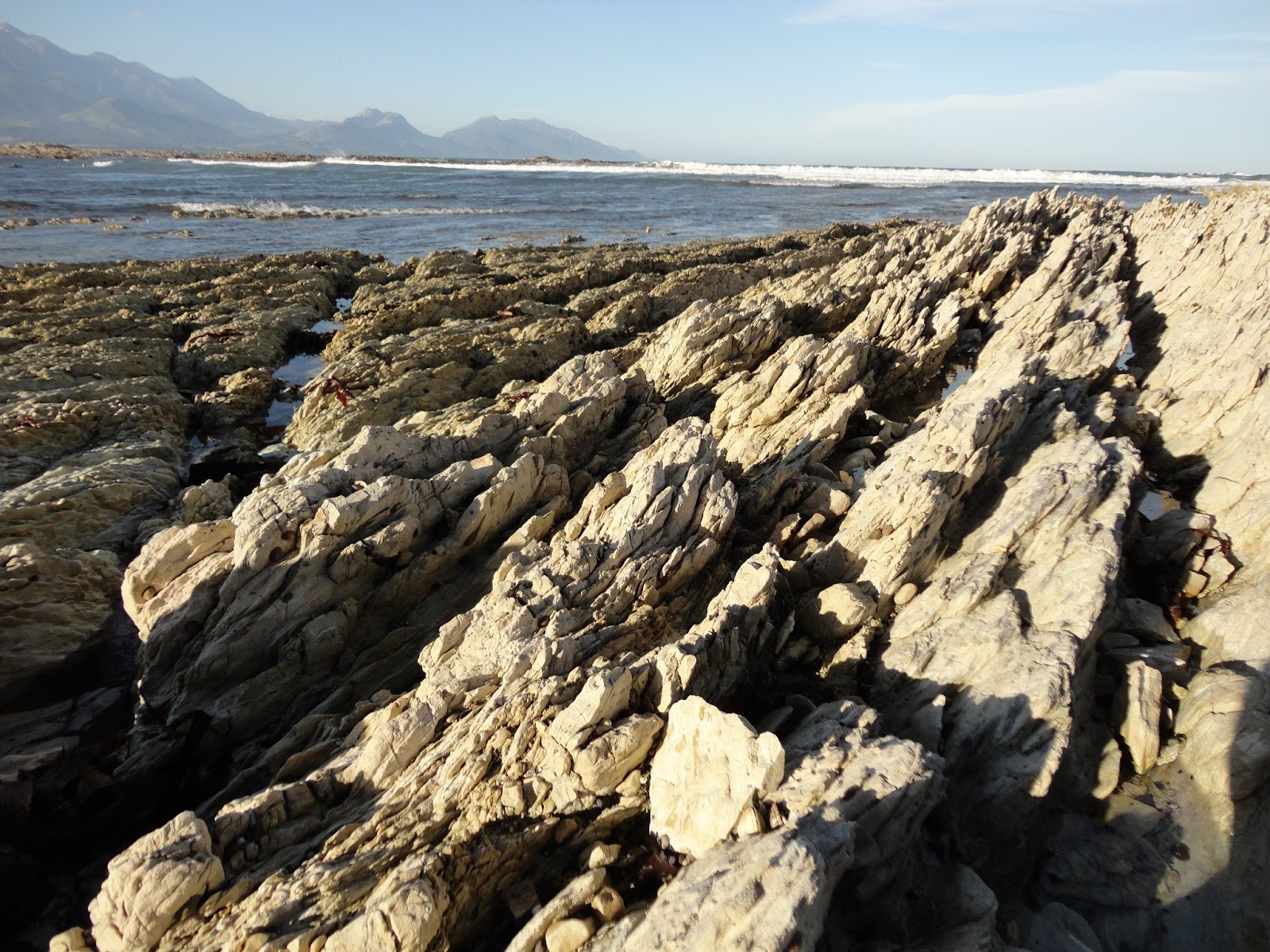 It’s a
nice walk, by the ocean. I can see the mountains in the distance, and the water
is so blue, so green, and the rocks are sometimes white and square, sometimes
pummiced, and some of the larger base rocks are wonderfully striated, and I’ve
got Gimli’s voice in my head when he says, “And then we’ll go through Emmens-weil,
a maze of Razor-Sharp-Rocks!” and I’m
like, “Gimli, You are so right! If these were taller, and a little sharper,
that’s what this would be!”
It’s a
nice walk, by the ocean. I can see the mountains in the distance, and the water
is so blue, so green, and the rocks are sometimes white and square, sometimes
pummiced, and some of the larger base rocks are wonderfully striated, and I’ve
got Gimli’s voice in my head when he says, “And then we’ll go through Emmens-weil,
a maze of Razor-Sharp-Rocks!” and I’m
like, “Gimli, You are so right! If these were taller, and a little sharper,
that’s what this would be!” 
I find
the barbeque seafood truck, and after much deliberation I get a paua patty.
Paua is New Zealand Abalone. But this is like, a frozen patty that’s been
unfrozen, and is now greasy and breaded and in between two pieces of white
bread that have been coated in butter. It’s mushy and not terribly good.
I walk
on.
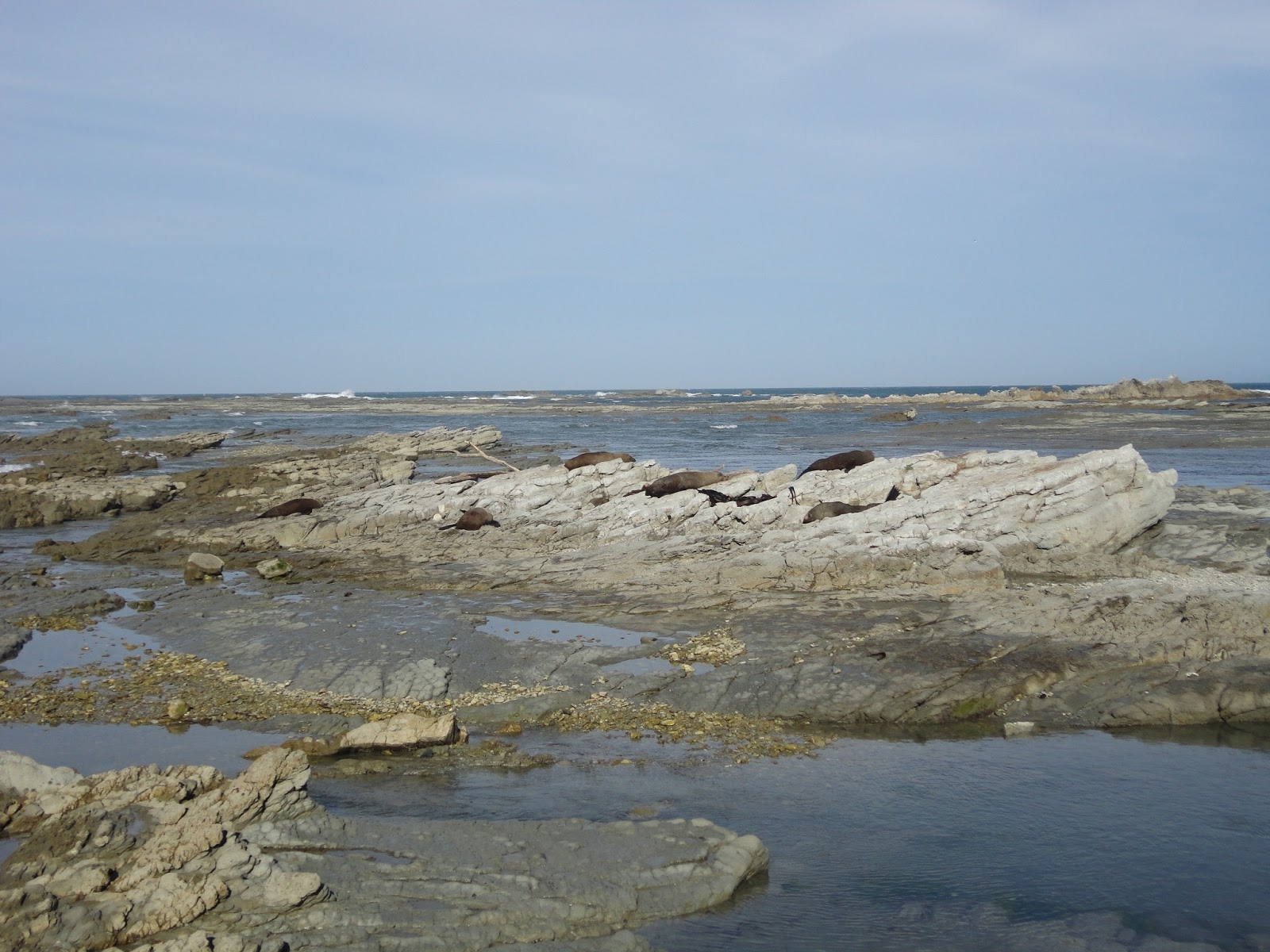

The Seal
Colony is a parking lot that looks out at a round jut of rock into the ocean,
where the Seals have decided they will go to sun themselves. In fact, they like
this area so much that they don’t mind that there are humans all over the
freaking place. There is one seal right in the middle of the parking lot,
taking advantage of the hot asphalt. When I pass by this seal the first time I
assume it’s dead, because it has a pink nose and is lying daigonally across a
parking space. When I pass by it the second time it snuffles and coughs and wiggles
around, rearranged himself more comfortably, and goes back to sleep. People are
taking pictures quite close. This seal has no problems with that.
Most of
the seals are on a raise of rocks a little way out—i.e. not in the parking lot.
They don’t move much, just sleeping in the late afternoon light, the warm,
glowing, summer light.
When I
go back to my room there’s a German girl in the room. She’s crying, I think,
but before I can tell her that it’s ok, I can leave, she hastily exits, and
I’ve got the room to myself.
My Seal
Swim starts at 9:30 the next morning. I walk into town with my entire pack, all
a hundred million pounds of pack. The Seal Swim has told me I can keep all my
bags there during the swim, even after the swim, until my bus comes to take me
to Christchurch, where I will get my plane to fly back to the states.
This
morning I forget to eat breakfast.
They
put us in wetsuits. Some of the thirteen year olds complain about this, so I
pull out some of the stories of various times at Synchro camp where the really
thin girls got borderline hypothermia from the outdoor swimming pool. I’m like,
“That pool was warmer than this ocean, and you’re about her size, so I would
put it on, if I were you!”
BAM.
Horror story = End of whining.
We see
some dolphins when we are in the boat on the way to the spot where we will
watch the seals; the dolphins swim quite close to the boat. It is exciting and
lovely. They are maybe two feet from us.
And
then they take us to a large boil of rock, just sticking out of the water maybe
two or three stories, with seals all over it. Some of the seals are playing the
water below. They go deep sea fishing for three days at a time, so when they
come back up on land they’re utterly exhausted. Like, totally done. So they
just sleep for a million hours a day. But they get overheated because their fur
is really thick, to protect them from the cold water at such depths, so they
have to go into the water and cool down. And they have to be in the water for a
while, because their fur is so thick that the water doesn’t actually penetrate
and get to their skin for a while. That’s when we can swim with them.
It’s
started raining, but it doesn’t bother us that much. We’re in the water, and it’s
not that cold, with our wetsuits on. Every once in a while a bubble of water
will slip under the suit—up my arm or under my chin or shins, but my general
body heat disperses those jewels of cold quickly enough so that I don’t notice
them too much.
There
are a couple seals there with us, mostly playing with each other. We’ve been
warned ahead of time that they may not interact with us—they may ignore us
completely. These guys are champion
ignorers—they’re tusseling and could care less that several blobbey humans in
bright yellow fins are staring at them.
I feel
a little weird, actually, because it’s not so much “swimming” with the seals,
as it is “floating and watching the seals swim in close proximity.” I’m glad
that they don’t seem to care, but I feel awkward. If I were playing outside, I
would not want a group of creatures gathering to stare at me. Undoubtedly cool,
but again—oh god, my geek is showing—after the initial oooh and ahh of an up
close seal wears off, I am almost more excited and mystified by the seaweed and
by the very tiny, almost invisible creatures floating around in groups that I
can see with my snorkel mask (so clear!!!).
The
seaweed is thick, and long, a dull green and yellow, and it moves with the
water in sinuous shapes, bellowing in and out. It has a sort of handsome
sentience, a sort of power to it. I don’t think that it will wrap me up if I
get close, but I do feel like it will
wrap me up. And I’m not sure if that’s a bad thing. I’m not sure if I wouldn’t,
actually, totally enjoy that. When I snorkel through the seaweed that floats at
the surface it’s surprisingly stiff, like walking through those plastic hanging
curtains in factory situations. It doesn’t look stiff. It looks like ribbons,
like bedsheets, like a down comforter.
The
seals are flipping and playing and have their mouths locked on each other,
whirling around and around. Their eyes are big, sort of square ish, and milky
white looking, underwater. I’ve heard that seal eyes—in fact, most undersea
creature’s eyes—are flat, and most land creature’s eyes are round. Something to
do with the light.
Here’s where I rant about the other people on
the trip. Not the gorgeous German family with their six foot two son who looks
like he has just stepped out of a Ralph Loren Summer Sports Ad, who is also in
my group and who I have no problem swimming with—but the more portly gentleman
who can’t quite maneuver himself in the water and keeps bashing me in the head
with his flippers, and keeps getting too close to the rock (which we are
supposed to keep away from, in order to give the seals their space) and in
general is a blunderbus.
But not
all of us can be awesome-sauce synchronized swimmers, so I’ll move on.
When I
get back into the boat it’s sunny, and warm, and I peel off my top layer of
wetsuit so that my arms are showing, and I notice that my left shoulder is
beginning to peel. Despite the Ralph Loren Model sitting opposite me, this
shoulder peeling occupies my attention for the entire trip back to the Seal
Swim head quarters.
I am
just so not capable of continuing my own species, it’s not even funny.
I
shower and change at the Seal Swim headquarters, and then I get my official big
extravagant New Zealand Meal in town. I get a seafood salad—it has a quarter of
a crayfish, some mussels and some calamari. I also get a dish of mashed
potatoes because I am cold and need something starchy. (Sarah Burke! I thought
of you!)
It is
delicious, but I had forgotten to bring my camera. I am sorry. The Crayfish
tasted similar to lobster, but maybe not as sweet. So. There you go. Now you
know. Also, the Mashed Potatoes are amazing.
Kaikora
is my last stop. That afternoon I board the bus to Christchurch, and then from Christchurch
I get another bus to the airport.
In the
airport I attempt a fancy maneuver wherein I stay up all night so that I will
then sleep soundly for the entire trans-pacific flight. I spend the time
writing stuff for my blog and peeling the skin on my shoulder, which has
blossomed into a massive bubbling, roiling mass of flaking skin. It’s utterly
disgusting and I’m glad that most of the people here in the airport are asleep
so I don’t gross them out too much.
The
not-sleeping attempt doesn’t work. What happens is that by the time morning
rolls around, I am so tired, and so queasy, that I am worried about barfing all
over my flight from Christchurch to Sydney, so I sleep on that flight, instead.
So when
I get on my flight trans-pacific, I have had enough sleep to keep me awake, but
not enough to keep me awake permanently, so I continue to drift in and out
every other hour or so. I do have pills in my bag that are supposed to make me
drowsy, but they are all the way up in the overhead bin, and the two people
next to me are large, bald (shaved bald) Australians. I do not know if these
two men knew each other before the flight, but they are two peas in a pod, and
get along famously. The one closest to me jiggles his leg a great deal. They
make large hand gestures. For some reason I cannot ask them to move so I can
get to my bag, even though I am screaming, in my head, to just ask them to
move.
We land
in LA at around 7AM their time, which is I don’t know even what it is my time.
But I’ve been up for about thirty six hours, by this point, with only a couple
hours of plane sleep. I go through customs. Again, I tell them about
everything. I don’t tell them about my collection of rocks. I don’t think they
need to know about those. But I DO tell them about the dirt I’ve found in the
treads of my hiking boots. They should know about that in case there are
bacteria they don’t want getting into the US.
They
send me all the way through to the agricultural people with their special
scanners, but when I show them my boots, with my special tired anxious face,
they look at me like, “bitch, why are you wasting our time.”
And
then they say, “Just be sure to wash them whenever you get to where you’re
going.”
And I’m
like, “THIS IS HOW THE WOOD BORER BEETLE GOT INTO THE COUNTRY. WE’RE ALL DOOMED.”
But then I’m also worried about them scanning my bags and finding those rocks.
And
then there’s another couple hours of waiting in LA. We board the plane in LA at
noon. It’s a three hour flight. We land in Minneapolis at six PM, and it’s
dark.
HOW DID
THAT HAPPEN. I DON’T UNDERSTAND. Literally. Where did the sun go? And the
hours?
It’s a
complete mystery to me—especially since the first time I took this trip, from
Minneapolis to LA, the flight was like, FIVE HOURS LONG. And now it’s only
three? And somehow time is cut in half?
HOW.
Very
very confused.
When I
get out of the airport and pick up my bag, the cold of winter bitch-slaps me in
the face, and it’s only 40 degrees out. I’m still peeling my sunburn.
Logan
Adams, from the MFA program, picks me up. He lives in Minneapolis because he’s
all cool and hip and urban. He used to have dreads. Then he used to have a faux
mohawk. Now he has a really cool wife and makes really good food and writes
really good fiction. Also they have a shower with two shower heads (What.
That’s an important detail. How many of you have that?).
So
Logan picks me up from the light-rail and I’m basically like, “Thanks so much,
I really appreciate—“and then I burst into tears.
But
Logan is great. He’s like, “Here is this awesome food I made that you will eat.
Amelia. Here is my shower. Here is this inflatable mattress. Whatever’s Clever.
Here is your own space with a closeable door and a significant lack of Germans.
Marxism. Here is breakfast the next morning with eggs and bacon that I’ve just
like, whipped up together. Reddit. Here’s twelve hours of sleep just handed to
you on a freaking platter.”
After
twelve hours of sleep I can once again understand the concept of time zones.
I catch
a bus to Ames. Megan White picks me up at the bus stop and looks at all my
rocks!
My cats
welcome me home too. They are Beautiful. Haroun is the exact color gray of a
paua shell. Suri is a super snuggler.
Why did I leave them? Oh yes. Sheep.
Sun. Sea.
Sarah
Burke asked me, during a welcome back everyone breakfast at the Grove (a diner
place in Ames) if it was surreal to be back in Ames. How can I answer that
question? It may be a good one. I think I felt surreal after coming back from
France. But now it feels different. I
was there. New Zealand was real. Now I am here. This place is real too. Gay and
Ron have been emailing me, which makes me feel very good. I like that. Simon emailed once, as well, but he’s
backpacking around and doesn’t have consistent internet. I miss them.
People
have been saying things like, “How was New Zealand?” and “So, tell me all about
it!” and “So, what was the best part!?”
I
cannot answer any of those questions. I
mean, this blog alone has been ten posts of about 12- 15 pages each. That’s 120-150
pages of material. I am sorry, but I cannot tell you “all about New Zealand” in
a ten minute conversation. I feel as though I have explained. I have told. I do
not need to tell or explain again. I
don’t really want to talk about it. It is a special thing; It is a rock, it is
a stone, it is a glowing place that I keep it in my pocket, and I do not
necessarily want to keep sharing it, even though the sharing of it has helped
make it the glowing place it is. It has been a little strange, finding out that
so many people have been reading (or not reading) the blog. I don’t mind that
people read—I intended for them to read. But it makes me want to either never
talk to anyone again, or demand that everyone read the blog right now, so that
we’re all on the same page and they don’t ask me such ridiculous
questions.
When I
was in New Zealand I felt like I was so alone and that this was the only way to
communicate, but now I feel like everyone knows everything and that’s a little
overwhelming. I guess that’s the point of writing. But that’s also the
wonderful thing about fiction. When you write fiction, people read but they
still don’t know anything. It’s still a mystery, there’s that element of
removal.
Anyway.
I imagine I’ll get over it.
The
next post will be pictures and descriptions of the flora and fauna of New
Zealand. I have to do some last bits of research so I get all my ducks in order
for it. Then I’ll post, and then that will be it.


